
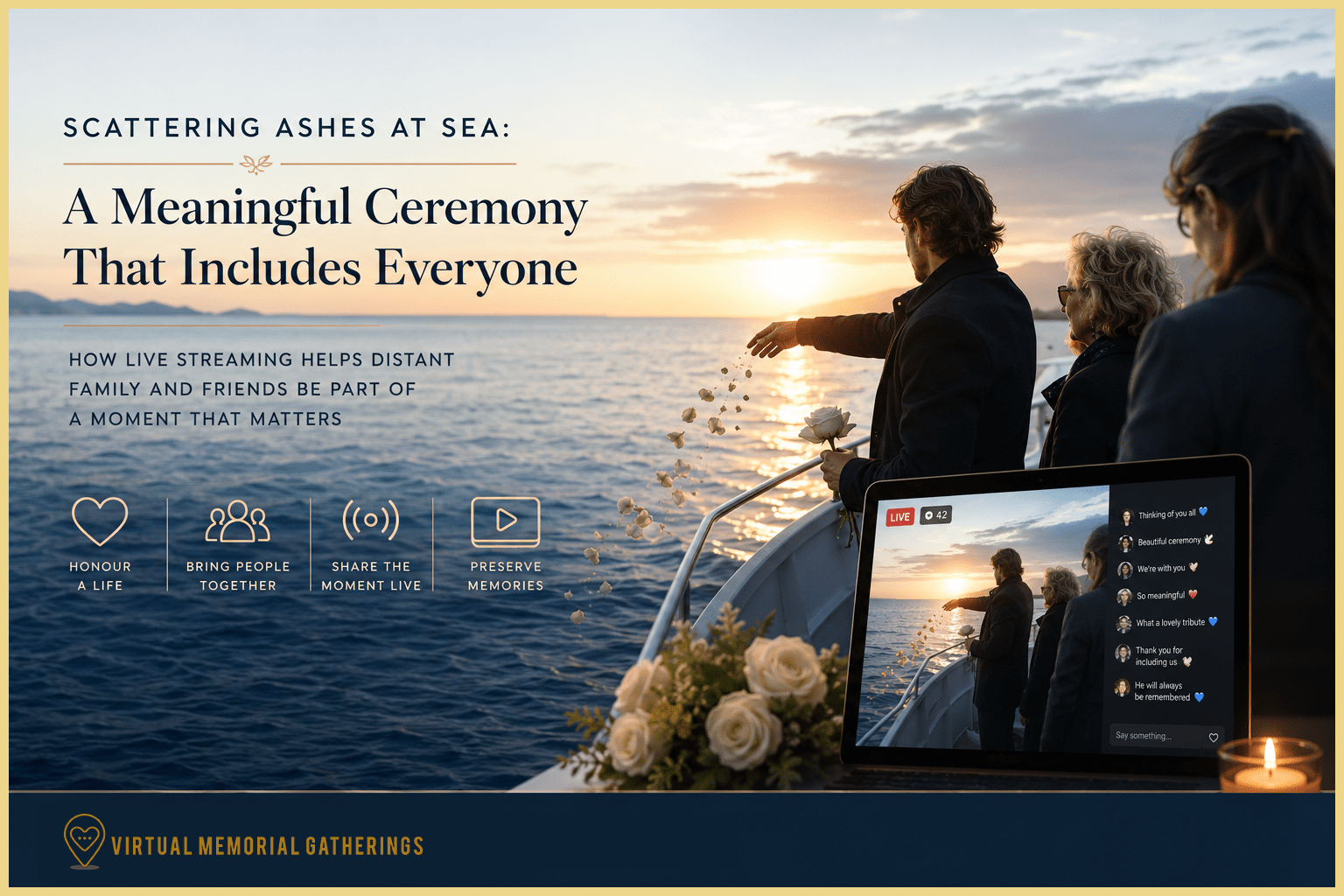
Scattering Ashes at Sea: Creating a Meaningful Ceremony That Includes Family and Friends Through Live Streaming
There is something deeply meaningful about saying goodbye beside the water.
For some families, scattering a loved one’s ashes at sea reflects a lifelong connection with the ocean. For others, the openness of the water, the horizon and the natural surroundings simply feel like the right place for a final farewell.
An ash-scattering ceremony can be beautifully simple or carefully planned with readings, music, personal reflections and traditions that reflect the person being remembered.
But there can also be a difficult reality: not everyone who wants to be there can board the boat.
Family members may live across the country or around the world. Older relatives may not be physically able to safely board a vessel. Friends may be unable to travel. The size of the boat itself may limit the number of people who can attend.
Live streaming can bridge that distance.
When thoughtfully incorporated into an ash-scattering ceremony, a live stream does more than allow people to watch. It can help distant family and friends experience the surroundings, hear the words being spoken, see the people gathered together and witness the final moment when their loved one’s ashes are returned to the sea.
The result can be an intimate ceremony on the water that still includes a much larger circle of people who loved the person being remembered.
Start With the Meaning of the Ceremony
Before thinking about cameras, boats or technology, think about the person whose life you are honouring.
Ask yourself:
Why does the sea have meaning for them or for our family?
What would they have wanted this moment to feel like?
Who should speak?
Is there a particular reading, prayer, poem or piece of music that belongs in the ceremony?
Are there stories that should be told?
Are there cultural, spiritual or family traditions we want to include?
What should happen immediately before the ashes are scattered?
How would we like the ceremony to end?
There is no requirement that an ash-scattering ceremony follow a particular format.
Some families want a brief and private farewell. Others create a complete celebration of life lasting 30 minutes or longer.
The most meaningful ceremonies are generally those that feel authentic to the person being remembered.
A Simple Order of Service for an Ash-Scattering Ceremony
A ceremony at sea might follow a structure such as:
Welcome
Someone welcomes those aboard the vessel as well as family and friends attending through the live stream.
Opening words
A celebrant, family member, clergy member or designated speaker explains why everyone has gathered and acknowledges the significance of the location.
Reading, prayer or poem
Choose something that reflects your loved one’s beliefs, personality or relationship with the sea.
Personal reflections
Invite one or two people to share memories or speak about the impact your loved one had on their lives.
Moment of remembrance
Allow a period of quiet reflection. Sometimes the sound of the water and the surroundings provide everything that is needed.
Scattering of the ashes
The immediate family or designated individuals release the ashes according to the family’s wishes and applicable local requirements.
Flowers or another symbolic gesture
Depending upon local environmental regulations, families may choose an appropriate natural tribute.
Closing words
End with a final reading, blessing, quotation or personal farewell.
Return journey
The journey back can be intentionally less formal, giving those aboard time to talk, reflect and support one another.
The ceremony does not have to be elaborate. A few carefully selected elements can carry enormous emotional significance.
Include Your Online Guests From the Beginning
One of the most important decisions when live streaming an ash scattering is whether remote guests will simply watch or whether you want them to feel intentionally included.
Acknowledging them can make a significant difference.
At the beginning of the ceremony, the person leading the gathering might welcome both those aboard and those joining remotely.
A simple acknowledgement such as, “We know many people who loved Dad could not be with us physically today, but we are grateful that you are joining us from around the world,” immediately establishes that the online audience is part of the gathering.
The camera then becomes less of a recording device and more of a window through which those family members and friends can share the experience.
Let Remote Guests Experience the Setting
An ash scattering at sea has something that a traditional indoor funeral does not: an extraordinary natural setting.
Allow the live stream to capture it.
Before the ceremony begins, viewers might see:
-
The vessel leaving the harbour
-
Family members gathering on deck
-
The coastline in the distance
-
Waves moving alongside the boat
-
Birds overhead
-
The changing horizon
-
The location where the vessel eventually stops
These images provide context.
Someone watching from another city should not feel as though they are simply watching people standing in front of a camera. They should have an opportunity to understand where the family is and experience some of the atmosphere surrounding the ceremony.
There may also be moments when nobody needs to speak.
Holding the camera on the ocean for a few seconds after the ashes have been scattered can be remarkably powerful.
Silence is part of a memorial ceremony too.
Capturing the Moment the Ashes Are Scattered
This is usually the emotional centre of the ceremony, and it should be treated with sensitivity.
The camera operator should know in advance:
-
Who will be holding the ashes
-
Where that person will stand
-
Which direction the ashes will be released
-
Whether several family members will participate
-
Whether flowers or another tribute will follow
-
Whether a prayer, reading or music will accompany the scattering
Good planning prevents the camera operator from having to move around unnecessarily during a deeply personal moment.
It can also be worthwhile to continue filming after the ashes have been released.
The embrace between family members, a quiet look toward the horizon or a few moments of reflection may become some of the most meaningful parts of the recording.
Why Professional Audio Matters at Sea
Families naturally think about the video when planning a live stream, but clear audio is equally important.
A ceremony on a boat creates particular challenges.
Wind, waves, engines and movement can make voices difficult to hear if the proper equipment is not used.
A professional live-streaming setup may use microphones positioned on the principal speakers along with equipment designed to minimize environmental noise.
This becomes especially important during readings and personal tributes.
For someone watching hundreds or thousands of kilometres away, being able to clearly hear a son speak about his mother or a granddaughter read a favourite poem is far more important than having a perfectly composed camera shot.
Plan for Internet Limitations on the Water
Live streaming from a boat requires additional preparation because internet connectivity may change as the vessel moves away from shore.
Before the ceremony, discuss the planned route with the vessel operator and live-streaming provider.
Your streaming team should consider factors such as:
-
Cellular coverage along the route
-
Distance from shore
-
The location where the ceremony will take place
-
Backup connectivity options where available. For example, in many locations Virtual Memorial Gatherings offers a satellite Internet connection for ceremonies at sea
-
How the event will be recorded if the internet connection becomes unstable
A professional recording should ideally be made independently of the internet connection.
That way, even if the live broadcast experiences a temporary interruption, the complete ceremony can still be preserved for the family and made available for viewing afterward.
Families should also understand that no provider can guarantee cellular connectivity in every offshore location. Planning for that possibility is part of responsible production.
Consider Creating a Private Memorial Viewing Page
Rather than simply sending guests a generic video link, consider creating a dedicated memorial page for the event.
The page can become a central place where family and friends find:
-
The date and time of the ash-scattering ceremony
-
The live stream
-
An obituary
-
Photographs
-
Instructions for viewing
-
A guestbook
-
The recording after the ceremony
For distant family members, this creates a more thoughtful experience.
Instead of receiving a technical link to a broadcast, they arrive at a space that is clearly dedicated to the person they are remembering.
Add a Memorial Tribute Video
A short tribute video can also complement the ceremony.
It might contain photographs from childhood through later life, family photographs, short video clips and meaningful music.
Depending upon the circumstances, the tribute can be shown before the vessel leaves, incorporated into an online memorial page or made available after the ceremony.
It also provides something that the family can keep long after the ash scattering has taken place.
Choose Your Speakers in Advance
Speaking at an emotional event can be difficult.
Choosing speakers beforehand provides everyone with an opportunity to prepare.
Consider asking speakers to keep their remarks relatively brief, particularly on a boat where guests may be standing and environmental conditions can change.
You might invite:
-
A spouse or partner
-
A child or grandchild
-
A sibling
-
A lifelong friend
-
A colleague
-
A clergy member
-
A professional celebrant
You do not need many speakers.
Two heartfelt tributes can sometimes say far more than ten formal speeches.
Consider Working With a Celebrant
Families sometimes know exactly what they want to say but are unsure how to put an entire ceremony together.
A celebrant can help create the structure of the gathering, prepare opening and closing words, coordinate readings and speakers and guide the ceremony itself.
This can be particularly helpful when immediate family members want to experience the ceremony rather than carry the responsibility of managing it.
The celebrant can also acknowledge family members watching remotely and help make the live-stream audience part of the ceremony.
Think About Safety and Comfort
A ceremony on the water requires considerations that do not arise at a funeral home or chapel.
Speak with your vessel operator about:
-
Accessibility
-
Passenger capacity
-
Boarding requirements
-
Weather conditions
-
Appropriate clothing and footwear
-
Seasickness
-
Life jackets and safety procedures
-
Washroom availability
-
Seating for older passengers
-
The amount of time the vessel will be at sea
You should also confirm the laws and environmental requirements governing the scattering of cremated remains in the jurisdiction where the ceremony will take place.
A reputable charter company, funeral professional or appropriate government agency can help you determine what requirements apply.
Prepare for Weather
The ocean rarely follows a script.
Wind can rise. Rain can appear. Seas can become rough.
Create a contingency plan before the day of the ceremony.
Ask what happens if the vessel captain determines that conditions are unsafe. Determine whether the ceremony can be delayed or rescheduled and how remote guests will be notified.
It is much easier to make these decisions calmly in advance than while grieving on the morning of the ceremony.
Preserve the Recording
The live stream serves an immediate purpose: allowing people to attend.
The recording serves another.
Weeks, months or years later, family members may want to return to that day.
The recording captures voices that may become precious. It preserves the words that were spoken, the people who gathered, the condition of the sea and that final view toward the horizon.
For some families, it becomes an important part of their family’s history.
Consider keeping more than one copy of the finished recording and sharing it privately with close family members.
An Ash-Scattering Ceremony Can Be Both Intimate and Inclusive
There was once an unavoidable choice with ceremonies held at sea.
Either you were on the boat or you missed the ceremony.
Technology has changed that.
A small group can still have the intimacy of standing together on the water while dozens of family members and friends quietly join them from homes around the world.
They can hear the stories.
They can watch the family gather.
They can see the coastline disappear into the distance.
And when the moment comes, they can watch the ashes being released into the sea.
They may be watching through a screen, but they are witnessing the same moment.
That ability to bring people together is what makes live streaming particularly meaningful for an ash-scattering ceremony.
At Virtual Memorial Gatherings & Live Streaming, we believe technology should never become the focus of a memorial. Its purpose is to quietly make connection possible.
Families should be able to concentrate on remembering the person they love while experienced professionals take care of the details required to bring everyone else into the gathering.
Frequently Asked Questions About Live Streaming an Ash Scattering at Sea
Can an ash-scattering ceremony at sea be live streamed?
Yes, provided adequate internet or cellular connectivity is available at the location. Because coverage can change offshore, the planned route and ceremony location should be discussed with your streaming provider in advance.
What happens if the internet connection is lost?
The ceremony should ideally also be recorded locally. If the live stream is interrupted by connectivity issues, the complete recording can then be provided or placed on the memorial page afterward.
Can family members watch from another country?
Yes. A web-based live stream can generally be watched from an internet-connected phone, tablet or computer regardless of where the guest is located.
Do remote guests need special software?
Depending upon the live-streaming platform being used, guests may be able to watch directly through a private memorial webpage without downloading software.
How long should an ash-scattering ceremony be?
There is no required length. Some ceremonies last 10 or 15 minutes, while others include readings, music and tributes and may last 30 minutes or longer. The content should reflect the wishes of the family and the person being honoured.
Can music be included?
Yes. Music can be incorporated into the ceremony or memorial presentation. Your live-streaming provider can advise you about the best way to handle music within the broadcast.
Should we use a professional celebrant?
A celebrant is optional, but can be valuable when a family wants assistance creating the ceremony, coordinating speakers and guiding everyone through an emotional event.
Can the ceremony be watched afterward?
Yes. When a recording is made, it can be made available privately to family and friends after the ceremony.
Can a memorial page include an obituary and guestbook?
Yes. A personalized memorial page can bring together the live stream, obituary, photographs, viewing information, guestbook and eventual recording in one location.
Can an ash scattering be streamed from any boat?
Not necessarily. The vessel needs to be safe and appropriate for the ceremony, and the location needs sufficient connectivity if a live broadcast is required. Discuss the requirements with both the vessel operator and live-streaming provider before booking.
What if some family members cannot safely travel by boat?
This is one of the strongest reasons to consider live streaming. Older adults, people with mobility limitations, people who are ill and family members living far away can still witness the ceremony without making the voyage themselves.
Planning an Ash-Scattering Ceremony at Sea?
If you are considering a live-streamed ash-scattering ceremony, you do not have to work through the technical and planning decisions on your own.
Virtual Memorial Gatherings & Live Streaming can help you explore options for professionally capturing and live streaming a ceremony so family and friends who cannot be aboard the vessel can still share in this important farewell.
Our approach is simple: listen first, understand what your family wants, and then recommend an appropriate way to make it possible.
The technology should remain quietly in the background.
The person you are honouring should always remain at the centre.
