
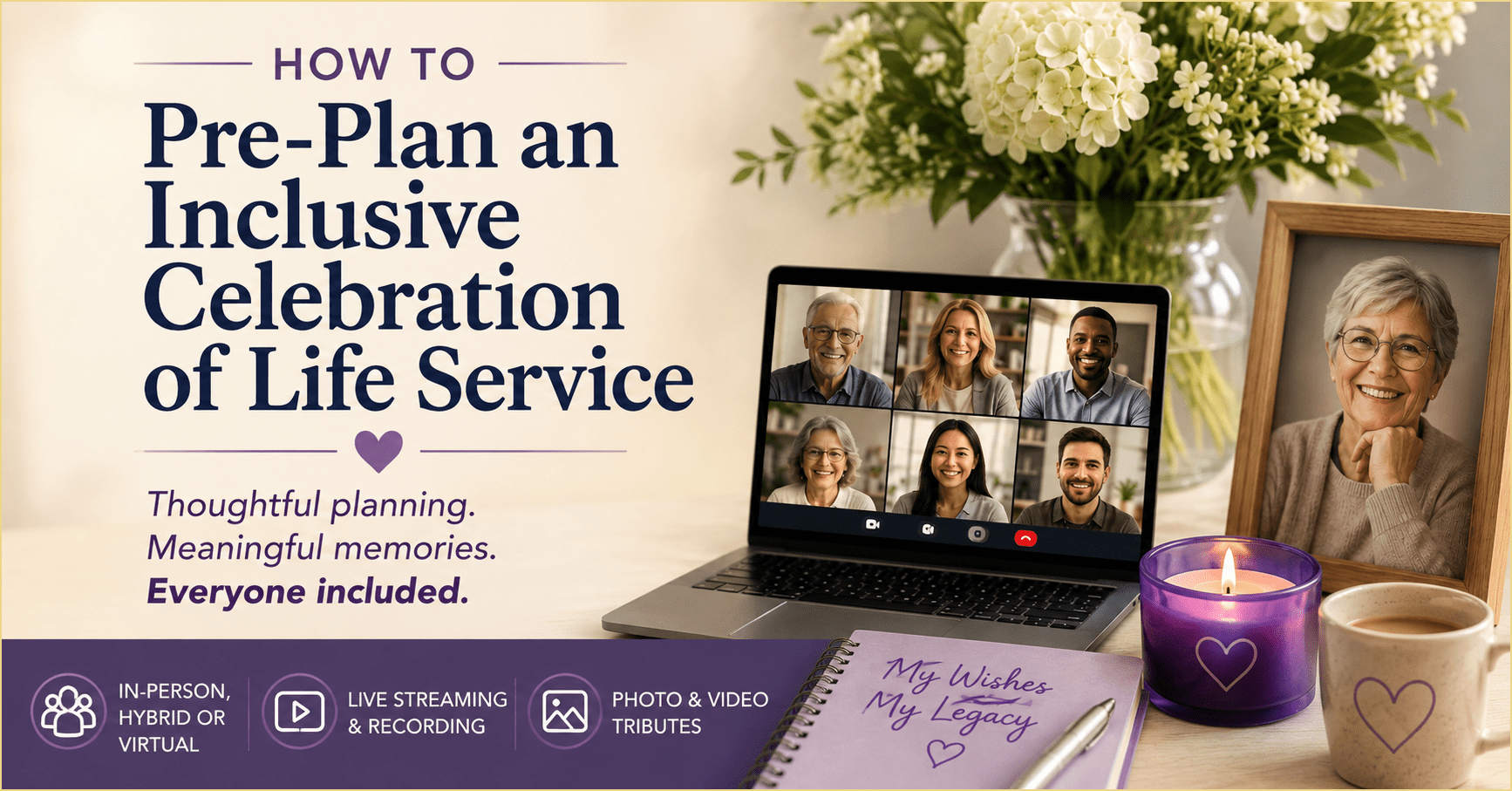
How to Pre-Plan an Inclusive Celebration of Life Service
Book a planning session with an experienced professional funeral/celebration of life event planner. We’ll guide you through the process and create a plan that can be followed by a designated family member or executor when you pass. Fee: $400 for a one-hour session.
How to Pre-Plan an Inclusive Celebration of Life Service
Planning your own celebration of life may feel like an unusual thing to do, but it can be one of the most thoughtful gifts you leave your family.
Pre-planning allows you to decide how you would like to be remembered, who you would like involved, what stories should be told, what music should be played, and how friends and relatives should be able to participate. Just as importantly, it removes many decisions from your family at a time when they may be grieving.
Today, pre-planning should also consider inclusion. Families and friendships often extend across cities, countries and continents. Some people may be unable to travel because of age, health, mobility, caregiving responsibilities, cost or other circumstances.
An inclusive celebration of life is designed so that the people who matter to you can participate—even if they cannot physically be in the room.
That can mean a traditional in-person celebration with professional live streaming, a hybrid gathering that allows remote guests and speakers to participate, or a completely virtual celebration of life where everyone joins online.
Here are some of the decisions you can make now.
1. Decide What You Want Your Celebration of Life to Feel Like
Before worrying about venues, technology or schedules, think about the experience you want people to have.
Would you prefer something formal and traditional? Informal and conversational? Spiritual? Musical? Filled with stories and laughter? Perhaps you would prefer a small family gathering followed by a larger virtual celebration involving friends from different parts of your life.
Ask yourself:
-
What do I want people to remember about me?
-
Which parts of my life would I like celebrated?
-
Are there particular values, accomplishments, relationships or experiences I want acknowledged?
-
Is there music that is especially meaningful to me?
-
Are there poems, prayers, readings or quotations I would like included?
-
Do I want a religious service, a non-religious celebration or elements of both?
-
Would I like guests to have an opportunity to share their own memories?
You do not have to plan every minute. Creating a general vision gives your family and the professionals assisting them a valuable starting point.
2. Think Beyond the Physical Guest List
When people pre-plan a funeral or celebration of life, they often imagine the people who will gather in a particular church, funeral home, community hall or other venue.
Consider a second question:
Who would I want there if distance were not an issue?
You may have former colleagues across the country, grandchildren studying overseas, lifelong friends who have moved away, or relatives who may eventually find travel difficult.
Professional live streaming can allow those people to watch a service taking place at a physical venue from a phone, tablet or computer.
You could pre-plan one of three common approaches.
In-Person With Live Streaming
Your service takes place at a church, funeral home, cemetery, community hall or other location. A professional videographer broadcasts it for people who cannot attend.
This is often the simplest way to make a traditional service more inclusive.
A Hybrid Celebration of Life
Some guests gather in person while others participate remotely.
Unlike a basic live stream where online guests primarily watch, a hybrid event can be designed to allow remote family members or friends to speak, offer a tribute, give a reading or participate in another part of the program.
This can be especially meaningful when someone important to you lives far away but you would still like that person to have an active role in the service.
A Completely Virtual Celebration of Life
Everyone participates online from wherever they happen to be.
This can be especially appropriate for families and friendship groups spread over a large geographic area.
Virtual gatherings can still include:
-
Speakers
-
Music
-
Photographs
-
Video tributes
-
Readings
-
A professional moderator or celebrant
-
Opportunities for guests to share memories
-
A virtual reception following the formal service
There is no requirement to choose between something meaningful and something virtual. The goal is to design the format around the people you want included.
3. Write Your Own Obituary—or At Least Start It
Your obituary is one of the most personal pieces of your final arrangements, yet it is often written by family members under considerable time pressure.
Why not give them a head start?
You can write a complete obituary now or create a document containing the information you want included.
Consider recording:
-
Your full name and preferred name
-
Birthplace and important places you have lived
-
Education
-
Career and professional accomplishments
-
Volunteer or community service
-
Organizations that have been important to you
-
Hobbies and interests
-
Significant life experiences
-
Names of family members
-
Causes or charities meaningful to you
-
Personal beliefs or values
-
A sentence or two describing how you would like to be remembered
Leave room for your family to update it later.
Try writing your obituary as a story rather than a résumé. Dates and accomplishments matter, but so do the things that made you who you are.
4. Start Collecting Photographs Now
One of the hardest tasks families face when organizing a celebration of life is suddenly trying to locate decades of photographs.
You can make that much easier.
Create a physical or digital collection of photographs that represent different periods of your life:
-
Childhood and school years
-
Young adulthood
-
Marriage and family
-
Children and grandchildren
-
Career
-
Travel
-
Hobbies
-
Holidays and celebrations
-
Friendships
-
Volunteer activities
-
Favourite places
-
Candid everyday moments
Don’t choose only formal portraits. Sometimes the photograph of you laughing at a picnic, cooking with family or working in the garden communicates more about your life than a professionally posed picture.
If possible, identify the people, places and approximate dates shown in older photographs.
A memorial event specialist can organize your photographs into a professionally produced video tribute using music of your choice. This tribute can certainly be created in advance.
The tribute can then be shown during an in-person, live streamed, hybrid or completely virtual celebration of life and retained afterward as a family keepsake.
You could even have much or all of your tribute video prepared during your lifetime and leave instructions for your family to add more recent photographs later.
5. Choose the Music for Your Life
Music has an extraordinary ability to bring back memories.
Create a list of songs you would like associated with your celebration of life.
You might choose:
-
A favourite song from your youth
-
Your wedding song
-
A hymn
-
Classical music
-
Music connected to your cultural heritage
-
A song your children or grandchildren associate with you
-
Something uplifting for the end of the service
You can also indicate where you would like particular pieces used—for example, during the opening, underneath a photo tribute or at the conclusion of the service.
Most importantly, explain why you chose them. That little bit of context may become part of the story your family shares.
6. Designate the People You Would Like to Speak
Think about who could tell different parts of your story.
Rather than simply naming one person to deliver a eulogy, you might designate several speakers:
-
A spouse or partner
-
A child or grandchild
-
A sibling
-
A longtime friend
-
A colleague
-
Someone from a community or volunteer organization
-
A faith leader or celebrant
You could even suggest what you would like each person to talk about.
One might speak about family life. Another could share stories from your career. A longtime friend might talk about adventures you had together.
And remember: a speaker does not necessarily have to travel to the service.
Virtual and hybrid formats can allow designated speakers to participate remotely from another city, province, state or country. A pre-recorded tribute can also be incorporated when someone is unable to participate live.
A professional funeral planner can help you collect these tributes in video form in advance.
7. Consider Recording Something Yourself
This is a deeply personal choice, but technology creates an option previous generations rarely had: you can leave a message in your own voice.
It does not need to be a farewell speech.
You might record yourself:
-
Telling a favourite family story
-
Sharing something you have learned about life
-
Talking about your family
-
Explaining why certain songs mean something to you
-
Sharing memories from your childhood
-
Expressing gratitude to the people in your life
You could also record conversations with your spouse, children, grandchildren or friends.
These recordings can become treasured family history whether or not they are ultimately incorporated into your celebration of life.
8. Make the Service Accessible
Inclusion is about more than geography.
When pre-planning, consider people who may have difficulty hearing, travelling, walking, driving or navigating unfamiliar technology.
Ask your event or funeral specialist about options such as:
-
Live streaming for people unable to travel
-
Simple online access without complicated software
-
Remote speakers
-
Recorded viewing for people unable to attend at the scheduled time
-
Online guestbooks
-
A memorial webpage with service information
-
Technical assistance for online attendees
These details can turn a service people merely watch into one in which they genuinely feel included.
9. Think About What Happens After the Formal Service
Some of the most meaningful conversations at a celebration of life happen after the formal program ends.
If you are planning a physical gathering, you might request a reception with food, photographs and informal conversation.
A similar experience can also be created online.
A virtual reception can give extended family and friends an opportunity to appear on camera, share a memory, tell a story or offer a few words about what you meant to them.
You might specifically state in your plans that you want time reserved for spontaneous storytelling.
Those unscripted memories are often among the most memorable parts of a celebration.
10. Decide Whether You Want the Service Recorded
A recording serves several purposes.
Someone may be hospitalized, travelling or simply unable to attend at the scheduled time. Others may want to watch the service again later.
A professionally produced recording can also become part of your family’s history, preserving the stories told about you for children, grandchildren and future generations.
If this matters to you, include it in your pre-planning instructions rather than leaving the decision until the day of the service.
11. Appoint One Person to Carry Out Your Wishes
A plan is most valuable when someone knows it exists.
Choose a trusted family member, executor or friend and tell that person:
-
Where your celebration-of-life instructions are stored
-
Which funeral home or provider you wish to use
-
Whether you have spoken with a memorial event specialist
-
Where your photographs and videos are stored
-
Who your preferred speakers are
-
Where your music selections can be found
-
Who should be contacted when the time comes
Provide a backup contact as well.
Do not leave your only copy inside a password-protected computer or device that nobody else can access.
12. Work With a Funeral or Memorial Event Specialist Before You Need One
You do not have to figure all of this out alone.
A funeral professional can help with the physical arrangements associated with death, burial or cremation.
A memorial event specialist can help you think through the actual celebration: its format, order of service, speakers, media, virtual participation, live streaming and production.
When planning in advance, you can discuss matters such as:
-
The structure of the celebration of life
-
Who will serve as celebrant or moderator
-
The order of service
-
Designated speakers
-
Music and readings
-
Photographs and video tributes
-
Live streaming
-
Remote participation
-
Memorial webpages
-
Online guestbooks
-
Rehearsals for speakers
-
Recording the service
-
Virtual receptions
-
Technical support for attendees
Pre-planning gives you the advantage of having these conversations when there is no immediate deadline.
You can ask questions, explore possibilities, document your preferences and change your mind later.
Create a Simple Celebration of Life Plan
Your plan does not need to be complicated.
A useful document might contain:
-
My preferred type of service: Traditional, celebration of life, religious, non-religious or another format.
-
Location: Where I would prefer the physical gathering to be held, if applicable.
-
Participation: In-person, live streamed, hybrid or completely virtual.
-
Celebrant or officiant: Who I would like to lead the service.
-
Speakers: The people I would like invited to participate.
-
Music: Songs or recordings I would like used.
-
Readings: Poems, scripture, quotations or other selections.
-
My obituary: Completed draft or biographical notes.
-
Photos and videos: Where they are stored and which ones are especially important.
-
Video tribute: Instructions for creating or completing a memorial slideshow.
-
Accessibility: Captioning, translation, virtual access or other considerations.
-
Recording: Whether I want the service recorded and made available afterward.
-
Reception: Preferences for an in-person or virtual reception.
-
My primary contact: The person authorized to coordinate the arrangements.
-
Service providers: Funeral home, celebrant, memorial planner and live streaming provider.
Review the document periodically as your circumstances, relationships and preferences change.
Frequently Asked Questions About Pre-Planning a Celebration of Life
What is an inclusive celebration of life?
An inclusive celebration of life is intentionally designed so that important family members and friends can participate regardless of geography, mobility, health or other barriers.
It may combine an in-person service with professional live streaming, remote speakers, recorded tributes, captioning, translation or a completely virtual gathering.
Can I pre-plan my own celebration of life?
Yes. You can document your preferred format, speakers, music, readings, obituary, photographs, video tributes, virtual participation and other wishes in advance.
You can also discuss your plans with your family, funeral provider and memorial event specialist so they know what you want when the time comes.
What is the difference between a live streamed and hybrid celebration of life?
With a live streamed service, the program generally takes place at one physical location while remote guests watch online.
In a hybrid celebration of life, both in-person and remote participants can be incorporated into the program. For example, a family member living overseas could appear on screen and deliver a tribute during a service taking place at a funeral home or other venue.
Can a celebration of life be completely virtual?
Yes.
In a completely virtual celebration of life, speakers and guests participate online from their homes or other locations.
The program can still include a celebrant or moderator, speakers, music, readings, photographs, tribute videos and opportunities to share memories.
Can people who are not comfortable with technology attend a virtual memorial?
Yes. A professionally organized virtual memorial can be designed to make joining as simple as possible.
Guests can receive straightforward instructions and, when available, technical assistance before and during the gathering.
This can be particularly helpful for older family members who may be less familiar with online meeting technology.
Should I write my own obituary in advance?
Writing your obituary in advance can be extremely helpful to your family.
You can prepare a finished version or leave biographical notes covering your family, career, accomplishments, interests, community involvement, beliefs and other aspects of your life you would like remembered.
Your family can update the information later when necessary.
Can I prepare my memorial video before I die?
Yes.
You can organize and digitize photographs, choose music and identify important video clips in advance.
You can also have a tribute video professionally created and leave instructions allowing your family to update it with additional photographs later.
Can family members speak remotely during a celebration of life?
Yes.
With a virtual or hybrid gathering, remote speakers can participate from another city, province, state or country rather than travelling to the physical service location.
This can make it possible for important people in your life to participate even when travel is not practical.
Should my celebration of life be recorded?
Many families choose to record a service so that people who cannot attend at the scheduled time can view it later.
The recording can also become a meaningful family keepsake and preserve the stories and tributes shared during the service for future generations.
When should I begin pre-planning?
There is no required age or particular time to begin.
If you already have opinions about how you would like to be remembered, documenting them now can make future decisions much easier for your family.
Your plan can always be revised.
Who should know about my celebration of life plans?
At minimum, tell your executor or the person most likely to coordinate your arrangements.
A spouse, adult child, close friend or other trusted person should also know where your instructions, photographs, obituary, contact information and other materials are stored.
Can a professional help me pre-plan the actual celebration?
Yes.
In addition to making arrangements with a funeral home, you can work with a memorial event specialist to document how you want the gathering to unfold.
This may include the order of service, speakers, celebrant, music, photographs, video tribute, live streaming, virtual participation, memorial webpage, guestbook and recording.
Pre-Planning Is About Making Your Wishes Known
A celebration of life tells your story.
Pre-planning gives you the opportunity to have a voice in how that story will be told.
You can choose the music. Preserve the photographs. Identify the people who know your stories. Write down the things that matter to you. And by considering virtual and hybrid participation now, you can make it possible for people you care about to be included regardless of where life has taken them.
You don’t have to make every decision today.
Start by documenting what matters most to you and sharing those wishes with someone you trust.
Virtual Memorial Gatherings & Live Streaming helps families plan and produce virtual celebrations of life, hybrid memorial gatherings, professional funeral live streams and memorial tribute videos. An advance consultation can help you understand the possibilities and begin documenting the type of celebration you would like your family and friends to experience.
Book a planning session with an experienced professional funeral/celebration of life event planner. We’ll guide you through the process and create a plan that can be followed by a designated family member or executor when you pass. Fee: $400 for a one-hour session.
